
QUICK ANSWER
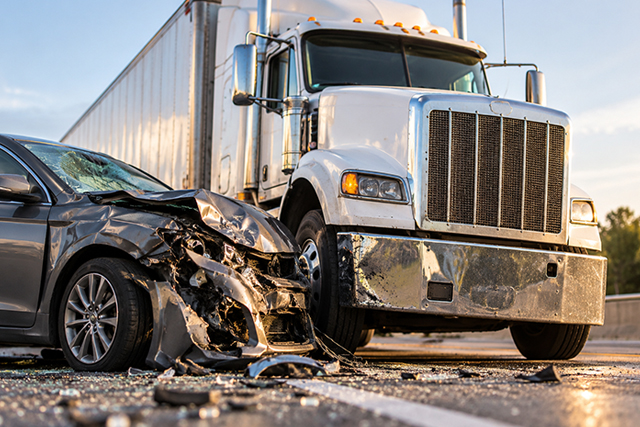
Truck and 18-wheeler accidents in Texas are governed by both state law and federal regulations. When a commercial truck driver or trucking company is negligent — whether through driver fatigue, improper loading, or failure to maintain the vehicle — they can be held liable for your injuries. These cases are more complex than standard car accident claims, and the trucking company’s insurance team will begin building their defense immediately. You should do the same.
Why Truck Accident Cases Are Different
Commercial trucks — including 18-wheelers, semi-trucks, and big rigs — can weigh up to 80,000 pounds when fully loaded. A passenger vehicle weighs roughly 4,000 pounds. That difference in mass means truck accidents frequently cause catastrophic injuries: spinal cord damage, traumatic brain injury, broken bones, and fatalities.
Unlike a typical car accident involving two private drivers, a truck accident usually involves multiple parties: the truck driver, the trucking company, possibly a freight broker, and whoever loaded the cargo. Each of these parties may carry separate insurance policies and share responsibility for what happened. Sorting out liability requires a thorough investigation — and it has to happen fast, before evidence disappears.
Federal and State Rules That Apply to Commercial Trucks
Commercial truck drivers and trucking companies operating in Texas must comply with both federal regulations and Texas law. When they violate these rules, that violation can be powerful evidence of negligence.
- Hours of service limits. Federal regulations under 49 C.F.R. Part 395 limit how many consecutive hours a commercial truck driver can operate a vehicle. Driver fatigue is a leading cause of serious truck accidents. If a driver exceeded these limits at the time of your crash, that is a federal violation that goes directly to negligence.
- Vehicle inspection and maintenance. Under 49 C.F.R. Part 396, trucking companies are required to systematically inspect and maintain their vehicles. Brake failures, tire blowouts, and steering defects that result from neglected maintenance are not accidents — they are the predictable result of failing to follow federal law.
- Commercial driver’s license requirements. Texas Transportation Code Chapter 522 requires commercial motor vehicle operators to hold a valid commercial driver’s license (CDL). A company that puts a driver behind the wheel without the proper credentials — or that ignores a driver’s disqualifying record — takes on serious liability.
- Cargo securement. Under 49 C.F.R. Part 393, cargo must be properly secured to prevent shifting or spilling. An unsecured or overloaded trailer can cause a jackknife, rollover, or debris in the roadway — all of which can result in devastating injuries to other drivers.
Common Causes of Truck Accidents in Texas
Texas has one of the highest volumes of commercial truck traffic in the nation, with major freight corridors along I-35, I-10, and I-20. The most common causes of serious truck accidents include:
- Driver fatigue from exceeding hours of service limits
- Distracted driving (phone use, GPS, in-cab electronics)
- Speeding, especially on rural highways
- Improper lane changes or unsafe passing maneuvers
- Brake failure or other mechanical defects due to inadequate maintenance
- Unsecured or improperly loaded cargo
- Driving under the influence of drugs or alcohol
- Inadequate driver training or hiring an unqualified driver
Who Can Be Held Liable?
Texas follows a modified comparative fault rule under Texas Civil Practice & Remedies Code § 33.001. This means that as long as you are less than 51% responsible for the accident, you can still recover compensation — though your award will be reduced by your percentage of fault.
In a truck accident, liability may fall on any combination of the following:
- The truck driver. For negligent driving, fatigue, impairment, or violations of traffic laws.
- The trucking company. Under the legal doctrine of respondeat superior, a company can be held liable for the negligent acts of its employed drivers. A company can also be independently liable for negligent hiring, negligent supervision, or failure to enforce federal safety regulations.
- The cargo loading company. If improper loading contributed to the crash, the party responsible for loading the trailer may share liability.
- A vehicle manufacturer. If a defective part — such as faulty brakes or a tire — caused or contributed to the accident, the manufacturer may face a products liability claim under Texas law.
What to Do After a Truck Accident
The steps you take in the hours and days after a truck accident directly affect your ability to recover compensation:
- Call 911. A police report is essential in a commercial truck accident case.
- Seek medical attention immediately — even if you feel okay. Serious injuries such as spinal damage and internal bleeding may not be obvious right away. A medical record from the same day ties your injuries to the crash.
- Document the scene. Photograph the truck’s license plate, the DOT number on the cab, the damage to both vehicles, the road conditions, and any visible injuries.
- Get witness contact information. Names and phone numbers of anyone who saw the crash.
- Do not speak to the trucking company’s insurance adjusters. They will contact you quickly. Do not give a recorded statement before speaking to an attorney.
- Do not post about the accident on social media.
- Contact a personal injury attorney as soon as possible. Trucking companies are required to preserve certain records — driver logs, GPS data, inspection reports, dashcam footage — but only for a limited time. The sooner you act, the better.
What Compensation Can You Recover?
Texas law allows injured victims to recover two main categories of damages. Economic damages cover your measurable financial losses — medical bills, future treatment costs, lost wages, and loss of earning capacity. Non-economic damages address what cannot be put on a receipt: your pain and suffering, emotional distress, loss of enjoyment of life, and the impact on your relationships and daily activities.
In cases where the trucking company’s conduct was especially reckless — for example, knowingly allowing a fatigued driver to operate a commercial vehicle — punitive damages may also be available under Texas Civil Practice & Remedies Code § 41.003.
How Long Do You Have to File?
In Texas, the statute of limitations for personal injury claims is two years from the date of the accident, under Texas Civil Practice & Remedies Code § 16.003. Missing this deadline almost always bars your claim entirely.
Two years sounds like plenty of time — but in truck accident cases, critical evidence can disappear within weeks. Dashcam footage is overwritten. Driver logs are discarded after the federal minimum retention period. Witnesses move or forget details. The sooner you contact an attorney, the better your chances of preserving the evidence you need.
Injured in a Truck Accident in Texas? We Can Help.
At the Law Office of Sovmya George, PLLC, we handle truck and 18-wheeler accident cases in Texas and Massachusetts on a contingency fee basis — you pay nothing unless we win your case. Trucking companies respond fast after an accident. You should too.
📞 972-905-0948 📧 admin@lawofficesg.com
Mon–Thurs 9AM–4PM | Fri 9AM–2PM
Sources
- Texas Transportation Code § 522 – Commercial Driver’s License Act (statutes.capitol.texas.gov)
- Texas Civil Practice & Remedies Code § 33.001 – Modified Comparative Fault (statutes.capitol.texas.gov)
- Texas Civil Practice & Remedies Code § 41.003 – Exemplary Damages (statutes.capitol.texas.gov)
- Texas Civil Practice & Remedies Code § 16.003 – Two-Year Statute of Limitations (statutes.capitol.texas.gov)
- Federal Motor Carrier Safety Administration (FMCSA) – 49 C.F.R. Part 395: Hours of Service of Drivers (fmcsa.dot.gov)
- Federal Motor Carrier Safety Administration (FMCSA) – 49 C.F.R. Part 396: Inspection, Repair, and Maintenance (fmcsa.dot.gov)
- Federal Motor Carrier Safety Administration (FMCSA) – 49 C.F.R. Part 393: Parts and Accessories Necessary for Safe Operation (fmcsa.dot.gov)
- Texas Department of Transportation (TxDOT) – Commercial Motor Vehicle Safety (txdot.gov)
This article is provided for general informational purposes only and does not constitute legal advice, nor does it create an attorney-client relationship. Personal injury law varies by individual circumstances. If you have questions about a specific situation, consult a licensed personal injury attorney as soon as possible.